
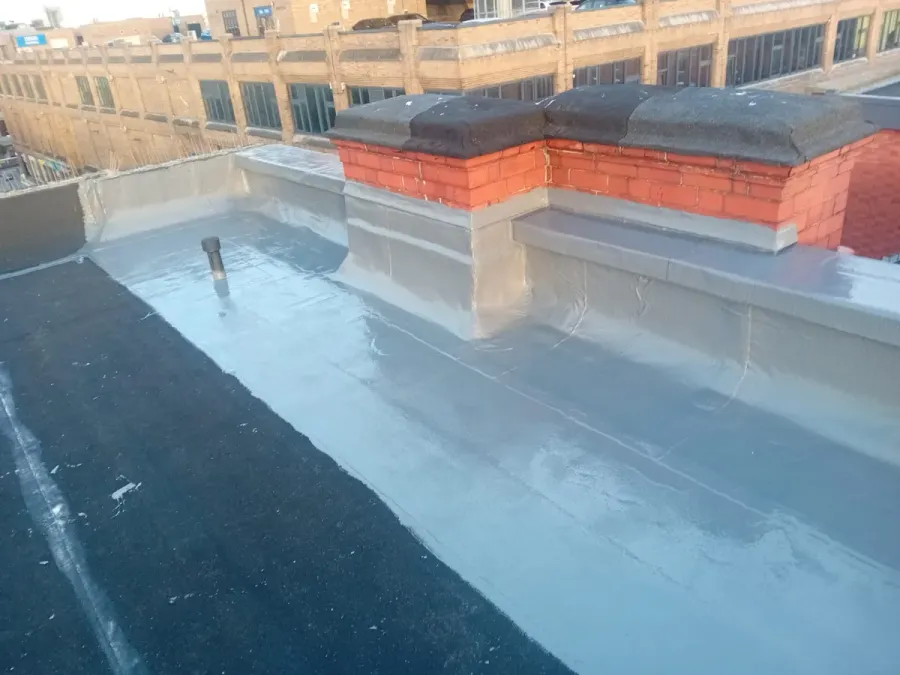
Flat roofs in Cork.
A flat roof that holds water is a flat roof that is wrong underneath. Roofers Cork look at the fall and the edges before choosing a membrane, so the new covering does not inherit the old problem.
Why flat roofs hold water, and what to do about it
No roof is truly flat. What we call a flat roof is really a low-pitched one, and its only protection is a slope too gentle to see: the fall. A commonly used design minimum is about 1 in 80, and good builders aim steeper. If the fall is too shallow, or the deck has sagged, water stops at the low spot and sits. Standing water finds every pinhole and seam, and it is heavy.
So the first question Roofers Cork ask about a flat roof is not what to lay on it but whether it drains. We check for puddles that last more than a day after rain, a deck that bounces or dips underfoot, and outlets that sit above the surrounding membrane. Where the fall is wrong, it is corrected in the build-up with tapered insulation or new firrings, because a new membrane over a pond is a pond with a warranty.
Edges and upstands are the next weak point. The place where the roof meets a wall, a chimney or a dormer cheek is the first place a flat roof fails, and it is usually a detail failure and not a membrane failure. Upstands need to be tall enough that water does not splash over them, and the membrane needs to turn up and be properly finished, with lead or a cover flashing above.
Once the base is right, the covering is a choice between EPDM and GRP. EPDM is a rubber sheet, bonded in a single piece with few seams. GRP is a fibreglass and resin layer applied in place, which suits small roofs with awkward shapes. Roofers Cork tell you which suits yours. The work carries the 10-year written workmanship guarantee.
How a flat roof can be put right.
EPDM rubber membrane
A single sheet bonded across the deck, with few joints for water to find. A good match for extensions and garage roofs of simple shape.
GRP fibreglass
Laid wet and set into one skin. Handles dormers, small awkward roofs and edge trims that a sheet struggles to follow.
Correcting the fall
Where water ponds, the build-up is reshaped with firrings or tapered insulation so the surface drains to the outlet.
New decking
Boards that are rotten, bouncing or delaminated are replaced before anything is laid on top.
Upstands and edges
Wall junctions, chimneys and trims are rebuilt to the height and finish that keep water out.
Outlets and drainage
Outlets cleared, raised or replaced so rainwater leaves the roof instead of sitting on it.
On every job, what the price covers.
Every quotation is a fixed price, so the final bill matches it.
Included in every job
Quoted separately
What this usually costs.
Our 2026 guide, plus VAT, is €90–€140 for each square metre of flat roof, whether EPDM or GRP, and it usually takes 2–5 days. Your own price is worked out from a measured survey, which also settles how much the fall, deck and edges need, and it is fixed in writing before the work starts.
From first visit to hand-back.
Measure up
We check the fall, the deck underfoot and each edge and upstand, with photographs.
Measured price
The roof is measured and priced per square metre, in writing.
Strip, repair, relay
The old covering is lifted, the deck and fall corrected, and the new membrane laid.
Finishing and hand-back
Trims, upstands and outlets are checked with you before we leave and the guarantee follows.
Questions, answered.
What does a flat roof cost per square metre?
In 2026 we guide €90 to €140 per m², plus VAT, whichever of EPDM or GRP suits. A measured, fixed price follows the survey.
Is EPDM or GRP better for my roof?
It depends on the roof. EPDM suits simple rectangles with few details. GRP suits small roofs with awkward shapes and many edges. Roofers Cork will tell you why one suits yours.
Why does my flat roof keep ponding?
Usually the fall is too shallow, the deck has sagged, or the outlet sits too high. A new membrane alone does not cure it, so the survey looks at the shape of the roof as well as its surface.
Can you fix just the leak?
Sometimes: a split seam or one failed upstand on an otherwise sound surface is a repair. A crazed, ponding surface is not, and relaying it is the better spend.
How long will the work last on site?
Most extension and garage roofs are done within two to five days, longer if the deck or fall needs real work.
Does a flat roof need ventilation?
The build-up needs to be designed so moisture is not trapped, and the survey checks this. How it is done depends on the insulation and the deck, so it is part of the written scope.
Can I walk or put things on my flat roof afterwards?
Light foot traffic for maintenance is fine, but a membrane is not a floor. If you want a terrace, a planter or a seating area, tell us at the survey, because that changes the build-up and the price.
More roofing services.
Roof Inspections
A written, photographed report on the state of the roof, taken from the attic and from the slope.
Lead Flashing & Chimneys
Lead dressed where the roof meets a wall or stack, and the chimney itself pointed so it stops taking in rain.
Emergency Roof Repair
A live leak or storm damage: the opening made watertight today, the proper repair planned once it is dry.
Roofers Cork cover Cork city and county. The survey is free, the price is fixed in writing, and the work carries a written guarantee.
Get your roof
looked at.
Write a line or two about the roof and where it is. After a free survey you get a plain written price. Rather talk it through? Ring: